Showing posts with label Glamor. Show all posts

Monday, April 16, 2012

The Great Gatsby and The American Mobster


    Americans have long been intrigued by crime. especially organized crime. Criminals have a sense of glamor about them that make for exciting conversations and stories. Their illegality, immorality, and general difference from the average life make criminals semi-heroes to the American public. Films such as The Godfather and books like The Great Gatsby provide examples of this, both in the works’ stories and in their receptions. The Godfather, although it portrays a family immersed and consumed by crime, it is hailed as one of the best films of all time. The stories and actors’ portrayals won the acclaim of the American people, not to mention Best Picture at the Academy Awards. Gatsby, like Don Corleone in The Godfather, is a man of mystique to his peers. He is seen and gawked at, but the people who know him never fully understood him.

    The Godfather and The Great Gatsby contain larger-than-life characters. Don Corleone, his son Michael, and Gatsby affect audiences because of how they are not relatable. Most people can’t seem to understand crime, so it intrigues them
Snazzy, Menacing Mobsters
to see criminals in person. Mobsters and the Mafia add another level of interest because of their organization. To the average person, the Mafia represents a government turned bad. It has its own social hierarchy and organization, but it is still criminal. Such order and precision in something that is normally associated with chaos fascinates people. The mob treats murder, cruelty, and illegality with complete familiarity and acceptance. What makes these criminals so appealing to an audience is their stark difference to normal life. People are amazed and awed by contrasts to normality. The characters in The Godfather are different both in their crimes and their nationality. The Italian origin of the Corleones adds to their mystique, like Gatsby’s experience in Europe and Oxford adds to his.

    Organized crime has a flair for the dramatic; petty larceny never interests people, but rigging the World Series or running a bootleg business can. Gatsby is a criminal, but he gives the people at his parties something to talk about, which elevates him above any simple thief. Because few people know Gatsby well, yet everyone knows who he is, no one at his parties can stop gossiping about what they think they know about him. His silence about his past only adds to this mystique. Indeed, the reader’s first glimpse of Gatsby is on a dark night a distance away, after which he vanishes inexplicably. At the first party Nick attends, a girl says of Gatsby, “You look at him sometimes when he thinks nobody’s looking at him. I’ll bet he killed a man” (44). Gatsby inspires awe in his admirers; no one knows exactly how he got his money, so they all assume that it had been obtained illegally. The people admire Gatsby for making his own money, for being a “self-made man,” but by making it in a way that is mostly taboo and by being secretive about it, Gatsby has inspired wonder in them. The main cause of this wonder is the secret-but-not-quite nature of it. Everyone suspects that Gatsby is a criminal, but no one has anything quite near proof of it. However, when faced with proof, when Gatsby is accused up front of his bootlegging successes, he falters, and Tom shames him into realizing that Daisy is out of his reach. From the beginning to 0:35 in the video shows Daisy and Gatsby running from Tom's accusations.


    When crime is out in the open and overt, criminals lose their “star status.” People see criminals who are caught as nothing but trouble and deserving of their prison sentences. Americans don’t like to be confronted with the criminal underbelly of their society; they are entertained by quick glimpses of it that keep the mystery, but when it is completely revealed, they are quick to distance themselves from it. After Tom reveals Gatsby’s bootlegging and gambling schemes, Daisy and Nick lose their
Crime Isn't All Glamor
respect for him. He becomes a broken man and relinquishes all claim on Daisy. Nick says, “Then I turned back to Gatsby- and was startled at his expression. He looked -and this is said in all contempt for the babbled slander of his garden- as if he had ‘killed a man.’ For a moment the set of his face could be described in just that fantastic way” (134). Nick has no respect for the people who gossip about Gatsby’s glamorous past; when confronted with the truth of the matter, the idea of “killing a man” becomes horrific rather than exciting. Gatsby's crimes, though not as severe as murder, are a badge of shame on an otherwise proper man.  By being unmasked as a criminal, Gatsby loses all respect and admiration he once had. He is a now just a man fleeing from his accuser, and if he had not been killed, he would certainly have been put to trial and been subject to the derision and shaming of his peers..

The reaction to a criminal depends on the crime and the person. Were Gatsby and the Corleones simple shoplifters or murderers, they would not have received the positive reactions from their crowds of adoring fans. Gatsby had a perfect life set up: he had money, a future wife, and a great house to throw parties in. Any whisper of his criminal past only served to further his reputation and mystique. A good criminal leaves an aura of mystery around the crimes, leaving people to wonder if it actually were committed. Society punishes bad criminals, both with legal action and with ostracizing. An unmasked criminal is only someone to be ashamed of and to be abandoned. Americans are fascinated with illegal action, but when confronted with it directly, they revile the same people they used to gossip about.


Patrick O'Hare

Saturday, April 14, 2012

Bullets and Broads: Celebrated Criminality in "Chicago" and "The Great Gatsby"

"...You are about to hear a story of murder, greed, lust...all those things we hold dear to our hearts."
-The MC


"In case you shake apart and want a brand new start
to do that jazz."
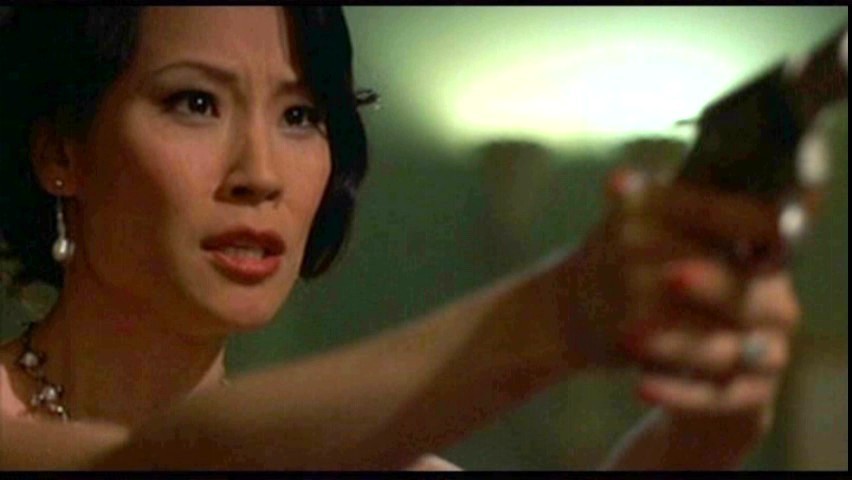
In the musical "Chicago," we follow the story of Roxie Hart (the blond woman on the right in the above picture), a feisty and ambitious young woman living in Prohibition-era Chicago. As the charismatic MC states in the musical's opening line, this show's risque nature is revealed almost immediately, when Roxie and her lover, Fred Casely, are shown in the throes of passion as the ensemble sings the seductive "All That Jazz" in the background. Things take a turn for the worst when Roxie shoots Casely to death for breaking up with her. It all goes downhill from here, as the cops drag her to prison soon after the crime.


It is in prison that she meets the famous Velma Kelly (the woman on the left in the above), a performer-turned-murderess who has become famous for the brutality of her crime. Kelly shirks Roxie's fangirl behavior at first, but when Roxie teams up with Velma's lawyer, the silver-tongued Billy Flynn (pictured in the center), she gains her own stardom, as Flynn turns her crime into an even bigger treasure than Kelly's.

 
Flynn works the press like puppets in the song "Both Reached for the Gun."

Roxie goes on to become a superstar within prison walls, surpassing Velma Kelly with her celebrity. The public goes wild when the two decide to team up, fulfilling Roxie's long-time wish of being a famous performer, and regaining Velma's celebrity (which Roxie had snatched entirely).

Adele's hit song "Rumour Has It" is a great fit
for Gatsby, as it deals with the flagrant and
infectious nature of rumors.
This theatre classic connects seamlessly to the celebrated criminality in The Great Gatsby. Even before we officially meet Gatsby for the first time, Nick hears wild rumors about his origins and wealth, ranging from him being "a German spy during the war" to "he killed a man" (44). Nick, though appalled at the ridiculous claims made by Gatsby's guests, is impressed. He remarks that "It was a testimony to the romantic speculation he inspired that there were whispers about him from those who had found little that it was necessary to whisper about in this world," exclaiming his wonder in Gatsby's ability to entice the wealthy with his (supposed) criminality.


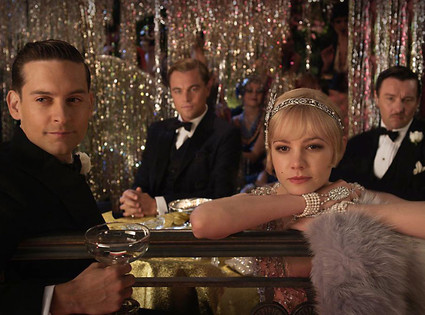
Gatsby is, in many ways, very similar to the heroine of Chicago, Roxie Hart. Both are from poor roots. Both move to the East in search of a more exciting life (Gatsby from the West and Roxie from Mississippi [or so she claims to the media!]). And, most importantly, both have dreams of a better lifestyle that they achieve through criminality. The flashy and lavish nature of their success is seen on the left, in this scene from The Great Gatsby, showing one of Gatsby's parties. An interesting point about both the East and the American Dream is made in the similarity between Roxie and Jay's stories.

Regarding the East, both Fitzgerald and Ebb/Fosse emphasize the powerful criminal cultures there. In Gatsby’s case, Meyer Wolfsheim and his ilk provide the criminal element that leads to Gatsby’s great fortune. And in Roxie’s, her frenzied murder of her lover leads to her eventual fame. As both of these characters migrated from areas of the country they regarded as more boring and slow-paced when compared to the East, the similar way in which the East challenges them makes a statement. It argues that the faster, more wild life that the East promises is not for everyone, and that any dreams one hopes to procure there will come with a price. However, it also seems that the East is a place where normally malevolent deeds are not just allowed, but celebrated. In both of their cases, criminality is a road to success, corrupting the classically pure take that the American Dream usually is associated with.

In "Chicago," the song "Cell Block Tango" is an excellent medium that connects the frequent criminality seen in the East with the celebrated and, in this case, seductive nature of the crimes.
In the East, the American Dream is rewritten from the ideal of a poor man gaining wealth and luxury with nothing but a dream and hard work. Instead, it becomes a Dream in which wealth is achieved through underhanded means and connections. Both Wolfsheim and Billy Flynn serve as deceptive agents through which our protagonists reach fame, eliminating the need for the hard work that one is supposed to endure to reach the American Dream. Furthermore, in both of these stories, the supposed wealth and celebrity that Gatsby and Roxie attain are proven to be transparent in both of the works’ conclusions.

For Gatsby, his funeral is very nearly a no-show, showing that, ironically, his mystique lied purely in the mystery of his origins. Without his criminality to gossip about, the guests who flocked to his house every night for parties could care less about him.

And for Roxie, her stardom inevitably fades when yet another hotheaded young woman commits a vicious murder in Chicago, usurping Roxie’s throne and pushing her back into the anonymity that she dreamed so long of escaping. Her fame, as Flynn taunts towards the end of the show, was “a flash in the pan.”

Kitty Baxter, the latest murderess blowing up the Chicago papers with headlines as:
BULLETS AND BROADS! ANOTHER DAY, ANOTHER MURDER!
In the end, the East’s obsession with the charming magic of criminality will never truly fade, as those from more “boring” parts of the U.S. continue to flock there in hopes of grandeur. It is this cycle of hope and crime that fuels the theme of Criminal Celebrity that both Chicago and TGG employ, and will continue to fill the exciting East with “romantic speculation."