Showing posts with label rags to riches. Show all posts

Sunday, September 16, 2012

Study Guide to Fame


In current society, many of us are taught from a young age to look up to the rich and the famous. To a regular person on the street, it appears as though celebrities are living the American Dream. One of our main sources to have a look into their lives are gossip magazines. Whether the magazines contain fact, or are simply just tabloids does not really matter to those who read them. The magazines just stand for somewhat of "a study guide to help them fit in."

Today in the U.S. the ideas and imagery that come along with the American Dream are completely different than the ideas of the American Dream when the term was first originated. Today there is a corrupt connotation that comes along when I think of the American Dream. Originally, the American Dream was the idea that you could come to the U.S. as an immigrant and you could have equal opportunity, justice, freedom, and if you work hard enough and set your mind to it, you can be successful and create whatever kind of life you want. However, in The Great Gatsby, Fitzgerald is contradicting that ideal and basically says that you have to pretend to be rich or make your money in a corrupt way, and even then you might not fit it with the rich.

In The Great Gatsby, Myrtle Wilson is a poor woman who tries to appear rich many various ways. In Chapter two, when she goes to New York with Tom Buchanan, a man that has old wealth and represents the American Dream, she is everywhere. Myrtle is obsessed with the scene and she wants everything. When they are on the way to their apartment she buys a copy of the Town Tattle, which is a gossip magazine similar to OK! Magazine today. 
"She had changed her dress to a brown figured muslin, which stretched tight over her rather wide hips as Tom helped her to the platform in New York. At the news-stand she bought a copy of "Town Tattle" and a moving-picture magazine, and in the station drug-store some cold cream and a small flask of perfume," (27). 
Myrtle is obsessed with the rich and the famous, and she wants to embody them in everything they do. Throughout this chapter there are multiple instances when Myrtle tries to appear rich, like in this passage when she changes her outfit and has Tom but her everything that she wants.  This proves that the American dream was becoming corrupt because people were not creating themselves. They were simply copying others, even if the “others” were corrupt and criminal themselves.


Today the original American Dream has changed and has become more similar to Fitzgerald's definition. Americans are not only willing to believe everything they hear, but they are also willing to disregard the corrupt things that the rich and the famous do because we are so fascinated. A current  example was in 2009 when a huge scandal hit the news when Chris Brown abused his girlfriend, Rihanna. Chris Brown hid away from the spotlight for a brief period of time but when he came back in 2011 he had the strongest year of his carrer thus far. He did not face any consequences with his carrer in the long run, and he still has the same number of fans, if not more. Society did not just ignore what Chris Brown did, but they accepted it, and it helped his carrer because it brought more and more attention to him and he became more and more in the spotlight. In addition, people tried to blame the situation on Rihanna and said that she was being "annoying" and it was "her fault" that Chris Brown hit her. According to NPR, "Brown's fans don't think he did anything wrong," people tried to deflect the negativity on Chris Brown even though he was clearly the one in the wrong. This just shows how if you are popular and attractive, then you can remain popular, which draws a parallel to old money in The Great Gatsby.


In The Great Gatsby, Fitzgerald describes the people that come to Gatsby's parties as moths:
"In his blue gardens men and girls came and went like moths among the whisperings and the champagne and the stars," (39).
The use of "moths" and bugs through out this passage shows how the people that arrive at Gatsby's house are simple minded people who want to be a part of something greater. They just flock to the light without thinking about it and are obsessed with the scene. Today people flock to celebrities and have the desire to live vicariously through their lives despite their wrong doings and possible criminality. 


The connotation that comes along with the American Dream has changed in many ways. It used to be that you could create yourself and be original, but now people follow celebrities and design their lives after them. The definition of the American Dream has also changed because now it is nearly impossible to create the successful and carefree life that many people want. There are different circumstances today that makes accomplishing that dream very difficult. 


Wednesday, April 18, 2012

Gatsby's Life: A Vaudeville Show

     On October 24, 1881, a circus manager named Tony Pastor staged a revue in uptown New York City. This revue was wildly successful, and most historians regard it as the beginning of the Vaudeville sensation. Vaudeville was a genre of theatre in which each show was a series of completely independent acts placed one after another. The point of the show was pure entertainment and nothing else. This type of theatre was incredibly successful circa 1880-1930, and at the peak of it's popularity, a vaudeville venue was third in the nation's most used gathering places, after schools and churches. By observing the inner workings of Vaudeville, we can make sense of the ways in which Jay Gatsby from F. Scott Fitzgerald's The Great Gatsby achieved his fame and fortune. In many ways, Gatsby worked his way to his "American Dream" the same way a hopeful Vaudeville performer would have.
    In order to understand the similarities between Gatsby's life and Vaudeville, it is important to understand the way in which the Vaudeville business worked. Producers and managers owned certain Vaudeville "circuits", which were collections of up to 45 theaters that performers would cycle through, with every theater always having a full show of acts, but something new every time. Performers were never any one of note at first; they would literally walk in off the streets, show a producer their act if they could get them to sit down for five minutes, and if the producer liked them, he would throw them into his circuit. The rest was an upward battle for the performer. If the audience liked them, it would go noticed: they would get opportunities to play the bigger cities more, and often, they would be bought out by bigger and better producers to perform in bigger and better venues. However, the process truly was about who put on the best show.
   
     In a way, Gatsby's rise to fame is similar to that of a Vaudeville performer. He began as a no one with only a dream. The beginnings of his rise to fame can be observed during his first interaction with Dan Cody: "It was James Gatz who had been loafing along the beach that afternoon..., but it was already Jay Gatz who borrowed a rowboat, pulled out to the Tuolomee, and informed Cody that a wind might catch him and break him up in half an hour" (98). This scene is equivalent to an actor seeing an opportunity with a big producer and taking the charge, for Gatsby puts on his "act" before approaching Cody and getting his attention. This is what sparks his entrance into the Vaudeville circuit, for Dan Cody teaches Gatsby how to perform the part of a wealthy man and entertain the crowd.

   Another important way Gatsby is like a Vaudeville performer is the way in which his "American Dream" lies in the east, not the west. Most Vaudeville performers were not from the city, or even the East; the majority were picked up from small towns out west to join the "small time", from which they worked their way up. In Vaudeville, circuits were either known as being "the small time", "the medium time", or "the big time". "The small time" usually consisted of small venues that weren't actually theaters, and the circuits included mostly western cities and rural areas. On the other hand, the "big time" consisted of circuits that ran through theaters in New York City, Chicago, Boston, and other large Eastern cities. In the same way, Gatsby started out with humble beginnings on a farm in North Dakota, and he works his way to a wealthy bond trader in New York City. However, the novel suggests that perhaps this is not where the true American Dream lies. The last line of the novel, "So we beat on, boats against the current, borne back ceaselessly into the past," suggests that going east to pursue one's dreams in the 1920's is the wrong way to go. This line seems to even be prophetic in light of the decline of Vaudeville in the early 30's; as the film industry grew in New York City, Vaudeville died out. Historians believe that if more money had been invested into these "small time" and "medium time" circuits, the lifespan would have been stretched, perhaps even through the Depression. The middle class of the west, with little access to the cinema, would have willingly payed the cheap fee to see a Vaudeville show, even if cinema was a rising industry in the east. In the same sense, there is something sadly ironic and, as the novel suggests, inherently backwards about Gatsby's dream of going east.


Saturday, April 14, 2012

Bullets and Broads: Celebrated Criminality in "Chicago" and "The Great Gatsby"

"...You are about to hear a story of murder, greed, lust...all those things we hold dear to our hearts."
-The MC


"In case you shake apart and want a brand new start
to do that jazz."
In the musical "Chicago," we follow the story of Roxie Hart (the blond woman on the right in the above picture), a feisty and ambitious young woman living in Prohibition-era Chicago. As the charismatic MC states in the musical's opening line, this show's risque nature is revealed almost immediately, when Roxie and her lover, Fred Casely, are shown in the throes of passion as the ensemble sings the seductive "All That Jazz" in the background. Things take a turn for the worst when Roxie shoots Casely to death for breaking up with her. It all goes downhill from here, as the cops drag her to prison soon after the crime.


It is in prison that she meets the famous Velma Kelly (the woman on the left in the above), a performer-turned-murderess who has become famous for the brutality of her crime. Kelly shirks Roxie's fangirl behavior at first, but when Roxie teams up with Velma's lawyer, the silver-tongued Billy Flynn (pictured in the center), she gains her own stardom, as Flynn turns her crime into an even bigger treasure than Kelly's.

 
Flynn works the press like puppets in the song "Both Reached for the Gun."

Roxie goes on to become a superstar within prison walls, surpassing Velma Kelly with her celebrity. The public goes wild when the two decide to team up, fulfilling Roxie's long-time wish of being a famous performer, and regaining Velma's celebrity (which Roxie had snatched entirely).

Adele's hit song "Rumour Has It" is a great fit
for Gatsby, as it deals with the flagrant and
infectious nature of rumors.
This theatre classic connects seamlessly to the celebrated criminality in The Great Gatsby. Even before we officially meet Gatsby for the first time, Nick hears wild rumors about his origins and wealth, ranging from him being "a German spy during the war" to "he killed a man" (44). Nick, though appalled at the ridiculous claims made by Gatsby's guests, is impressed. He remarks that "It was a testimony to the romantic speculation he inspired that there were whispers about him from those who had found little that it was necessary to whisper about in this world," exclaiming his wonder in Gatsby's ability to entice the wealthy with his (supposed) criminality.


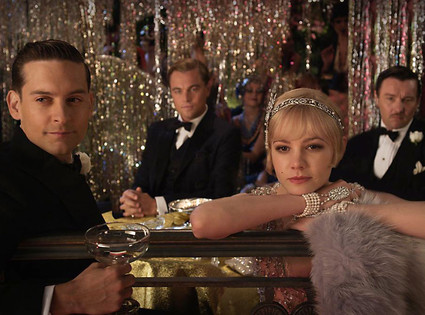
Gatsby is, in many ways, very similar to the heroine of Chicago, Roxie Hart. Both are from poor roots. Both move to the East in search of a more exciting life (Gatsby from the West and Roxie from Mississippi [or so she claims to the media!]). And, most importantly, both have dreams of a better lifestyle that they achieve through criminality. The flashy and lavish nature of their success is seen on the left, in this scene from The Great Gatsby, showing one of Gatsby's parties. An interesting point about both the East and the American Dream is made in the similarity between Roxie and Jay's stories.

Regarding the East, both Fitzgerald and Ebb/Fosse emphasize the powerful criminal cultures there. In Gatsby’s case, Meyer Wolfsheim and his ilk provide the criminal element that leads to Gatsby’s great fortune. And in Roxie’s, her frenzied murder of her lover leads to her eventual fame. As both of these characters migrated from areas of the country they regarded as more boring and slow-paced when compared to the East, the similar way in which the East challenges them makes a statement. It argues that the faster, more wild life that the East promises is not for everyone, and that any dreams one hopes to procure there will come with a price. However, it also seems that the East is a place where normally malevolent deeds are not just allowed, but celebrated. In both of their cases, criminality is a road to success, corrupting the classically pure take that the American Dream usually is associated with.

In "Chicago," the song "Cell Block Tango" is an excellent medium that connects the frequent criminality seen in the East with the celebrated and, in this case, seductive nature of the crimes.
In the East, the American Dream is rewritten from the ideal of a poor man gaining wealth and luxury with nothing but a dream and hard work. Instead, it becomes a Dream in which wealth is achieved through underhanded means and connections. Both Wolfsheim and Billy Flynn serve as deceptive agents through which our protagonists reach fame, eliminating the need for the hard work that one is supposed to endure to reach the American Dream. Furthermore, in both of these stories, the supposed wealth and celebrity that Gatsby and Roxie attain are proven to be transparent in both of the works’ conclusions.

For Gatsby, his funeral is very nearly a no-show, showing that, ironically, his mystique lied purely in the mystery of his origins. Without his criminality to gossip about, the guests who flocked to his house every night for parties could care less about him.

And for Roxie, her stardom inevitably fades when yet another hotheaded young woman commits a vicious murder in Chicago, usurping Roxie’s throne and pushing her back into the anonymity that she dreamed so long of escaping. Her fame, as Flynn taunts towards the end of the show, was “a flash in the pan.”

Kitty Baxter, the latest murderess blowing up the Chicago papers with headlines as:
BULLETS AND BROADS! ANOTHER DAY, ANOTHER MURDER!
In the end, the East’s obsession with the charming magic of criminality will never truly fade, as those from more “boring” parts of the U.S. continue to flock there in hopes of grandeur. It is this cycle of hope and crime that fuels the theme of Criminal Celebrity that both Chicago and TGG employ, and will continue to fill the exciting East with “romantic speculation."

Thursday, March 29, 2012

Jay-Z and Jay-Gatz, "Niggas" and Nouveau Riche in Paris and West Egg


This growth of punctilious discrimination as to qualitative excellence in eating, drinking, etc. presently affects not only the manner of life, but also the training and intellectual activity of the gentleman of leisure. He is no longer simply the successful, aggressive male,—the man of strength, resource, and intrepidity. In order to avoid stultification he must also cultivate his tastes, for it now becomes incumbent on him to discriminate with some nicety between the noble and the ignoble in consumable goods. He becomes a connoisseur in creditable viands of various degrees of merit, in manly beverages and trinkets, in seemly apparel and architecture, in weapons, games, dancers, and the narcotics.
- Thorstein Veblen, The Theory of the Leisure Class (1899)

What's Gucci, my nigga? What's Louis, my killa?
What's drugs, my dealer? What's that jacket, Margiela?

- Jay-Z, "Niggas in Paris" (2011)


Thorstein Veblen's concept of "conspicuous consumption" is as easy to apply to the quote nouveau riche unquote of hip hop as it is to fictional West Eggers like the theatrical eponymous MC of Fitzgerald's Great American Novel. Certainly Jay Gatsby has much in common with hip hop impresarios like Jay-Z himself--"The Great Gatsby" surely would have been a rap name if Fitzgerald had not taken it first; it even references the gatling gun popular both among the gangsters of the 1920s and the gangsta rappers of 1990s. More to the point, both Jay-Gatz and Jay-Z came from humble origins, both rose to prominence in part through nefarious means. As newly rich, then, they also share what Thorstein referred to as a "punctilious discrimination as to qualitative excellence." In short, they both know, and demonstrate their knowledge of, the best brands to buy in fashion, cars, and houses (see my reading of Jay-Z's reading of New York architecture). We might, then, view the extravagance of "Niggas in Paris," and Watch the Throne more generally, as hollow yet hopeful in much the same way that Fitzgerald seems to view Gatsby's manifold displays of wealth.


"Ball so hard, this shit weird
We ain’t even s’pose to be here,
Ball so hard, since we here
It’s only right that we be fair."
When Nick and Gatsby are passed on the Long Island Expressway by a limousine full of African Americans, the narrator thinks, "Anything can happen...even Gatsby could happen" (73). Fitzgerald thus aligns Gatsby's mysterious wealth with that of these newly and upwardly
mobile blacks--of course African Americans were making great strides during the Harlem Renaissance just as industrialists were achieving success during the "boom" of the Roaring Twenties. Again, Jay Gatsby and Jay-Z in particular share similar rags to riches American dream narratives. In telling his own success story, Jay-Z aligns himself with the era of the robber barons, naming his brand after the famous industrialist of the early twentieth century. In a way, so does Gatz in his reinvention of himself as Gatsby. Like the lower class Gatz, Jay-Z "ain't spose to be here"; he was born working class and they were born black. There is something that defies the odds in Jay-Z's success: as a young black man in postindustrial America--growing up in the Marcy Projects of Bed-Stuy--the statistics outline a grimmer fate. As he raps, "I'm supposed to be locked up," that is, in prison. Similarly, as a young working class man in industrial America, Gatz should never have made it even to West Egg.


The "spectroscopic gayety" of Gatsby's house parties is matched by the kaleidoscopic (almost epileptic!) bling bling of Jay and Ye in concert in the video for "Niggas in Paris" (49). Models and Gothic architecture are multiplied fantastically through digital effects throughout what is essentially a concert film. While Gatsby's mansion is a "factual imitation of some Hotel de Villein Normandy," it is Notre Dame de Paris that is appropriated by the rappers to evidence their presence in Paris and, more broadly, their "punctilious discrimination" (9). At roughly the 3 minute mark, the Parisian landmark is offered as bridge to Kanye's intro to the "Watch the Throne" theme. The whole Watch the Throne album at once a parallels Gatsby's celebrations of himself through his house parties and offers a social commentary on the meaning of such wealth similar to that in Fitzgerald's novel. While I for one was one of the first haters of the seemingly uncritical pomp of "Watch the Throne," like "East Egg condescending to West Egg," there is a social statement in the fact, as Jay raps in "Otis": "not bad, huh? for some immigrants" (49).
"Ball so hard, got a broke clock, Rolleys that don't tick tock
Audemars that's losing time, hidden behind all these big rocks."


Listening to Jay-Z and Kanye West's "Niggas in Paris," like many of their respective songs, requires a connoisseur's annotations for the multiple allusions to fashion and other luxury industries. We may know Gucci and Louis, at least by name, but Margiela? He's a Belgian fashion designer. Does Beyonce, like Daisy, cry at the beauty of Jay-Z's shirts? We may know about Rollex, but Audemars? Audemars Piguet is a Swiss luxury watchmaker with its origins in the nineteenth century. Jay's particular Audemars is so blinged out with diamonds that he can't even tell the time. We similarly need an encyclopedia to understand the many aristocratic allusions used to describe Gatsby's wealth: the "Marie Antoinette music rooms and Restoration salons" and "Adam study" of his West Egg mansion.


"I’d seen it. Everybody had seen it. It was a rich cream color, bright with nickel, swollen here and there in its monstrous length with triumphant hat-boxes and supper-boxes and tool-boxes, and terraced with a labyrinth of wind-shields that mirrored a dozen suns. Sitting down behind many layers of glass in a sort of green leather conservatory, we started to town."

Gatsby's Rolls-Royce is an emphatic display of his wealth, an attempt to prove his financial prowess and taste to condescending East Eggers. His choice of Rolls is a classic one, though he may have chosen too many options to the point that the car appears garish rather than staid, its "labyrinth of windshields [mirroring] a dozen suns" (68). Something different is going on in Jay-Z and Kanye West's destruction and recreation of DaimlerChrysler AG's Maybach 57 in the video for "Otis." The car cost $350,000 to buy and $150,000 to take apart. They literally dismantle a symbol of old wealth and rebuild it according to their own specs, and then proceed to joy ride with a four models precariously piled in the back seat. As "gentleman of leisure," West and Z prove themselves "connoisseur[s] in creditable viands of various degrees of merit," but they also rewrite the book of etiquette for such conspicuous consumption. With their joyous chopping and then joy riding of the Maybach 57, Z and West flaunt their own misappropriation of old wealth; unlike Gatsby, they are not trying to be anything but themselves. The Maybach 57 was sold at auction with the proceeds benefitting East African drought relief.